
"On the 17th"
1000 article(s) found

Cultural History of Fine Coffee Coffee Communication History (2)
The first European description of coffee in 1573 was through German doctors staying in Syria. In the second half of the 16th century, the European people who traveled on the east coast of the land gradually spread. The British East India Company was established in 1660 and the East India Company was established in the Netherlands in 1602. The East India Company refers to the trade between Asia and Europe, South Asia and the East in the 17th and 19th centuries.

Fine Coffee Science explains the spread History of Coffee in detail (2)
The first European description of coffee in 1573 was through German doctors staying in Syria. In the second half of the 16th century, the European people who traveled on the east coast of the land gradually spread. The British East India Company was established in 1660 and the East India Company was established in the Netherlands in 1602. The East India Company refers to the trade between Asia and Europe, South Asia and the East in the 17th and 19th centuries.

The History of the spread of Fine Coffee Culture and Common sense Coffee (2)
The first European description of coffee in 1573 was through German doctors staying in Syria. In the second half of the 16th century, the European people who traveled on the east coast of the land gradually spread. The British East India Company was established in 1660 and the East India Company was established in the Netherlands in 1602. The East India Company refers to the trade between Asia and Europe, South Asia and the East in the 17th and 19th centuries.

The History of the spread of Fine Coffee Culture and Common sense Coffee (2)
The first European description of coffee in 1573 was through German doctors staying in Syria. In the second half of the 16th century, the European people who traveled on the east coast of the land gradually spread. The British East India Company was established in 1660 and the East India Company was established in the Netherlands in 1602. The East India Company refers to the trade between Asia and Europe, South Asia and the East in the 17th and 19th centuries.

Yemeni mocha coffee: slightly sour and then strong
Follow the comments (Wechat official account vdailycom) found that the beautiful cafe opened a small shop of its own. Although Ethiopia was the first country in the world to discover coffee, Yemen was the first country in the world to produce coffee on a large scale as a crop. In the 17th century, the first batch of Yemeni coffee was exported to Europe through the ancient port of Mocha. This is Mocha.
The first coffee shop in the world
Coffee was an exclusive Arab drink for more than 1,000 years from the 7th century AD to the 17th century. With the gradual development of the commodity society, the Arabs brought the habit of drinking coffee to the countries and regions where they did business, about from the Balkans to Spain, and then to North Africa, and then the Roman Empire gradually transferred the Islamic world. The word coffee is in Constantinople Kaveh, in law

African Kenyan Coffee AA grading system Kenyan Coffee producing area Flavor
Professional coffee knowledge exchange more coffee bean information please follow the coffee workshop (Wechat official account cafe_style) front street-Kenya coffee grading system, a brief introduction to the development history of coffee has been recorded as early as the 8th century AD, coffee shops were also popular in the 17th century, while its neighboring countries

"Tian Ai Zun Shang" Coffee will be unveiled at the 18th Chinese Food Exhibition. Pure Vietnamese Coffee sweeps across Modu.
Shenzhen, May 3 / PRNewswire-FirstCall-Asianet / /-May 17-19, the 18th China International Food and Beverage Exhibition (SIAL China) will be held at the Shanghai New International Expo Center, when enterprises and dealers who have made positive contributions to the development of the food industry and food marketing industry will gather to show the development trend of global food and beverage. TNI Corporation will
Coffee dissemination chronology
Coffee spread to Arabia (eleventh century), Egypt, Syria. (13th century) Damascus (16th century) Europe (17th century) the first people to plan to grow and eat coffee were Arabs. At the beginning of the eleventh century, people in the Arab region boiled coffee into soup or dried it and then boiled it as stomach medicine. Because Muslim precepts are strict and alcohol is strictly forbidden, Muslims

Coffee dissemination chronology
Arab (eleventh century) Egypt, Syria (13th century) Damascus (16th century) Europe (17th century) the earliest people who planned to grow and eat coffee were Arabs. At the beginning of the eleventh century, people in the Arab region boiled coffee into soup or dried it and then boiled it as stomach medicine. Because of the strict Muslim precepts and forbidden to drink alcohol, Muslims

Six questions related to coffee can coffee suppress sexual impulses?
Can coffee suppress sexual impulses? in the early 17th century, when Europeans began to experiment with coffee, it was a popular idea in Britain that coffee could suppress sexual impulses, drink too much and even lose sexual ability, and it was a favorite drink for abstinent monks. Under this concept, it is worth noting that the first cafe in London was able to open around 1688. Relative to

The result of the 16th Nicaragua Excellence Cup in 2020 is announced. When will the auction of COE start?
Portland, Oregon (June 5, 2020)-the Coffee Excellence Alliance announced the winning Coffee at the 16th Outstanding Cup in Nicaragua. Nicaragua's winning cup returned to the country after an one-year truce, providing a total of 249 cups of coffee (of which 74% were produced for the first time). At this year's Expo, 17 cups of coffee won the Outstanding Cup, and 12 cups of coffee were awarded the national championship. Have to

Where did the earliest coffee come from? how was the earliest coffee handled in the first place?
The cultivation and production of coffee in the 17th century has always been monopolized by Arabs. At that time, it was mainly used in medicine and religion, and doctors and monks admitted that coffee had the effects of refreshing, awakening, strengthening the stomach, strengthening the body and stopping bleeding. The use of coffee was documented at the beginning of the 15th century and was integrated into religious ceremonies during this period. At the same time, it also appeared in the folk as a daily drink. Because of Islam

When did coffee become popular?
The cultivation and production of coffee in the 17th century was monopolized by Arabs. It was used mainly in medicine and religion, doctors and monks recognized coffee as refreshing, refreshing, invigorating, strengthening, hemostatic, etc.; the use of coffee began to be documented in the early 15th century, and it was incorporated into religious ceremonies during this period, as well as appearing in folk as a daily drink. Islam
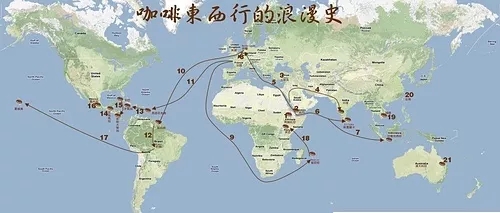
After reading the spread history of coffee, feel the romance of coffee traveling around the world.
Professional coffee knowledge exchange more coffee bean information Please pay attention to the coffee workshop (Wechat official account cafe_style) Coffee will become a world drink, is accompanied by the great navigation era of the 17th and 19th century, after three hundred years coffee beans, coffee seedlings planted all over the world, including the Netherlands, France brought coffee beans to colonization, newly developed regions of the Caribbean, Central and South America, the 19th century

How to drink coffee at home by first-class baristas flannel cloth hand brewed coffee Nel drip
Professional coffee knowledge exchange More coffee bean information Please pay attention to the coffee workshop (Weixin Official Accounts cafe_style) coffee making process flow chart-Starbucks coffee making process In the 17th and 18th centuries, European coffee was brewed by putting coffee powder and granulated sugar into water, with Turkish coffee as the mainstream. The problem is that coffee grounds stay in the mouth, feel strange, and taste very bad.

Under the new president of Cecafe, Brazil's coffee exports fell by 9.4% in February, while coffee harvest increased by 17.2%.
Professional coffee knowledge exchange more coffee bean information please follow the coffee workshop (Wechat official account cafe_style) Brazilian Coffee exporters Council (Cecafe) announced on February 8th that Nicolas Rueda, Chief Executive Director of EDF Man Volcaf Brasil, will serve as Chairman of the Brazilian Coffee exporters Council from 2021 to 2022. Gunter Hausler, general manager of NKG Stockler, will be responsible.
Coffee Story in Amsterdam Coffee background in Amsterdam
Professional Coffee knowledge Exchange more information on coffee beans Please follow the Coffee Workshop (Wechat official account cafe_style) the New World in the mid-17th century, coffee was brought to New Amsterdam and was later called New York by the British. Although cafes soon began to appear, tea remained the most popular drink in the New World until 1773, when the colonists rebelled against the expropriation of tea by King George III.

Who invented coffee flavor wheel? the origin of coffee flavor wheel?
The Africans invented it! Coffee is native to Ethiopia. It was used as a beverage in North Africa and West Asia for hundreds of years before it was introduced into Europe in the 17th century. Coffee plantations have been set up in all hot and humid parts of the world, and coffee has become a popular drink. But it takes a lot of days to make a pot of delicious coffee. Coffee beans must be ground into fine powder. Preferably more.

Vanishing Arabian Wild Yemeni Coffee beans
Although Ethiopia is the birthplace of Arabica, the first coffee that Europeans drank from the end of the 17th century to the beginning of the 18th century came from Yemen. At that time, all African or Arabian coffee was exported from the port of Mocha, so that Mocha became synonymous with coffee, while Harald, the capital of the city walls, became a supporting role. However, three hundred years later, Yemeni coffee is no longer what it used to be.